
Overview
Location
Solomon Islands
Year
2025
Sector
Methods
Seismic Refraction Tomography (SRT)
Multi Channel Analysis of Surface Waves (MASW)
Static Marine Seismic Refraction (SMSR)
Sub Bottom Profiling (SBP)
Background
GBG Group Australia was engaged to support the redevelopment of a key wharf in the Solomon Islands as part of a broader infrastructure initiative. The project required an improved understanding of subsurface conditions across both onshore and offshore environments to inform design and planning.
A desktop review of available borehole and historical data was completed to identify data gaps and inform the investigation design. The primary requirement was to extend subsurface interpretation beyond intrusive locations and develop a continuous understanding of ground conditions across the shoreline transition and reef slope.

Objective
To develop an integrated subsurface model across the onshore and offshore project areas, supporting the design of future port infrastructure.
Methods
The investigation combined Seismic Refraction Tomography (SRT), Multi-Channel Analysis of Surface Waves (MASW), Static Marine Seismic Refraction (SMSR) and Sub Bottom Profiling (SBP) to provide coverage across both land and marine environments.
Onshore methods utilised SRT and MASW to characterise subsurface stiffness and hardness, layering and depth to rock. Offshore methods utilised SMSR and SBP to map seabed sediments, reef slope geometry and underlying reef limestone.
The integrated approach enabled interpretation across the land–marine interface and improved correlation with existing borehole data.

Outcome
The investigation produced a robust integrated dataset and enabled development of a three-layer stratigraphic model across the site.
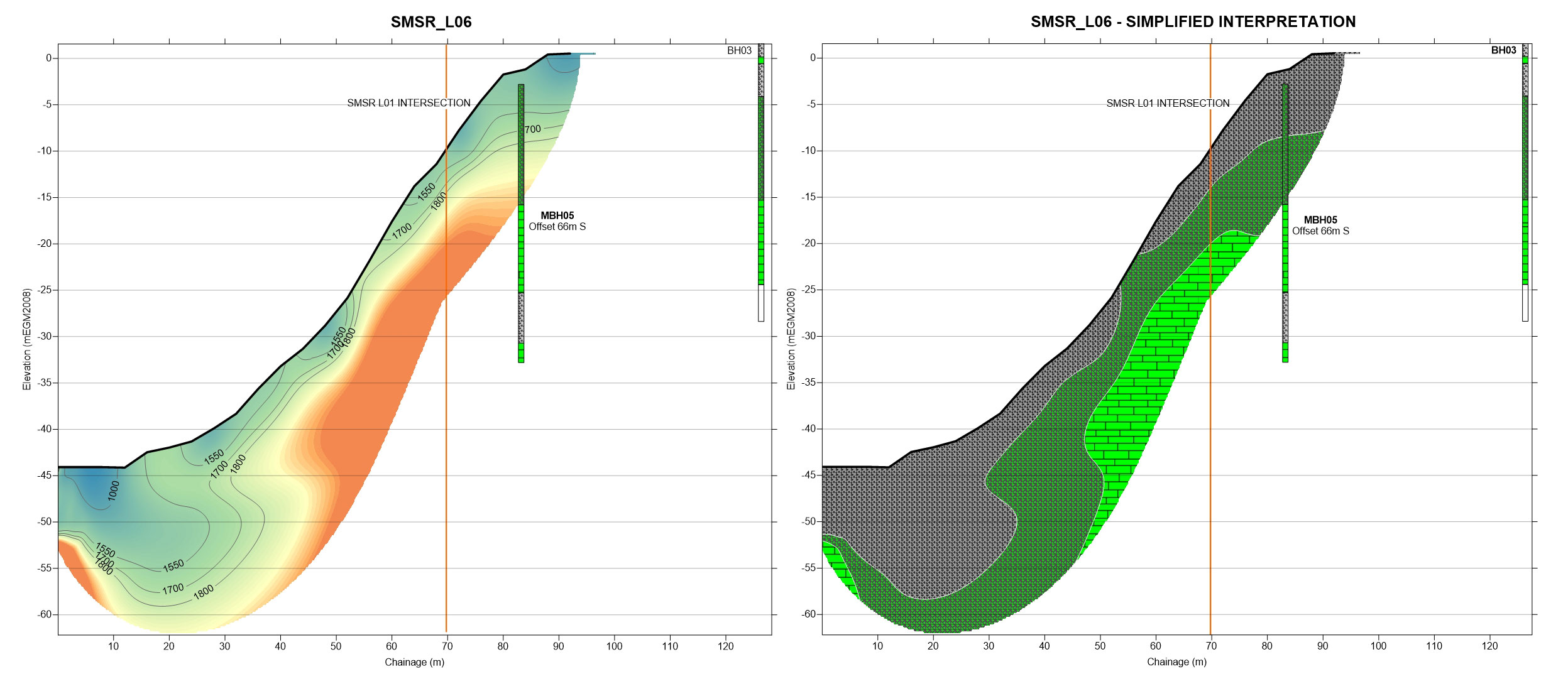
Results defined sediment layering along the reef slope, identified potential accumulation zones at the base of slope, and improved understanding of the underlying Pleistocene reef limestone. The combined datasets provided a continuous subsurface model across the project area, supporting design development and reducing uncertainty for future works.


